Coaching New Leaders (Part 2): One-on-One Leadership Coaching That Sticks
In Part 1, I shared how New Leader Orientation and group coaching give new leaders a strong, shared foundation. But some of the deepest growth happens in private. One-on-one leadership coaching is where a leader can be honest about what they’re truly struggling with — and where lasting change takes root. Here’s how I make one-on-one leadership coaching practical, measurable, and genuinely worth a leader’s time. (New here? Start with Part 1 on orientation and group coaching.)
Start With Objective Data, Not Opinion
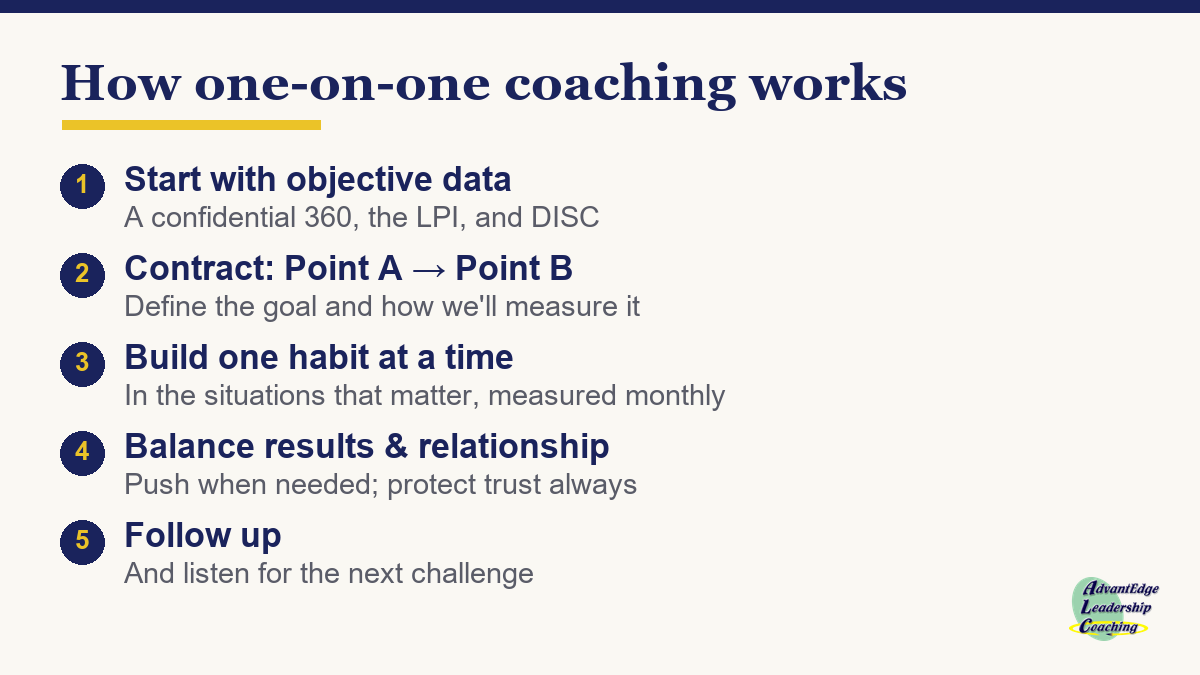
I begin one-on-one leadership coaching with objective data: a confidential 360-degree review and validated assessments like the Leadership Practices Inventory (LPI) and DISC (I’m certified in both). Informal feedback can sound judgmental or subjective; formal, science-based assessment gives a leader impartial data that’s far easier to accept. As the Center for Executive Coaching notes, data also gives your client a safe, constructive way to understand their challenges — and it reduces the defensiveness that can stall coaching before it starts. That insight into thinking style, values, and communication becomes our shared map of what a leader wants to change.
Contracting: Where You Are, and Where You Want to Go
Before we dive in, we contract. I confirm the leader actually wants coaching (not just their boss), clarify confidentiality and logistics, and make sure we’re anchored to something that matters to them. Together we define where they are now (Point A), where they want to go (Point B), and how we’ll measure the gap — concrete and observable, not vague. I gauge coachability honestly, too, because coaching only works when a leader genuinely wants to grow. And I’m clear about scope: I provide leadership coaching, not life coaching. I typically coach a leader for six to twelve months — weekly at first, then every other week, then monthly — asking at each session, “What would make this a great use of our time?”
One Leadership Habit at a Time
From the assessment, the leadership dashboard, and sometimes observing the leader in real meetings, we co-create a development plan — and then we get specific. We choose one new leadership habit to build, in the exact situations where it matters, and we track it monthly. A leader working on trust, for instance, might ask a handful of colleagues for feedback, then report how often they saw the new behavior. This is how I keep one-on-one leadership coaching practical, tangible, and valuable — change you can actually see, not just talk about. The topics leaders bring are wonderfully human:
- “My relationship with my boss (or a direct report) is poor.”
- “There’s so much to do that I can’t focus on what really matters” — overwhelm without burning out.
- “I can’t get anyone to buy into my ideas.”
- “My team isn’t aligned.”
- “I need to have a difficult conversation, and I’m not sure I have the skills” — the courageous conversations leadership demands.
- “How do I gain respect and credibility to lead former peers?”
Balancing Results and Relationship
Good coaching, as the Center for Executive Coaching describes it, balances a push for results with the strength of the relationship. Push too hard and a leader feels hounded; lean too far into rapport and we drift into friendly questions that never quite go anywhere. I stay in that balance — asking the questions with a little more voltage when they’re needed, while protecting trust. I also make a point of recognizing every win, no matter how small, and helping leaders acknowledge their own role in it. Most leaders are far too hard on themselves; part of my job is helping them see what they did differently, and grow their emotional intelligence and confidence alongside their results.
Great One-on-One Leadership Coaching Doesn’t Just End
When an engagement ends, it shouldn’t end cold. I build in a follow-up session — “How are you doing? Where are you on track? What would you like some coaching on in our remaining time?” It’s a simple way to show integrity and that I genuinely care. And I always listen for the next issue: not to build a codependent relationship or keep rehashing a solved problem, but to help a leader meet the next challenge, and the one after that. That’s how I stay a valued member of their team over time.
What This Looks Like in Practice
One new nurse manager I coached — brilliant clinically, but somewhat new to leading — came in referred by her leader because she failed to assert herself with her direct reports, seldom followed-through, and was falling behind on reports. Her team had some unprofessional, uncivil behaviors, and weren’t aligned with the Health system’s vision, mission, values, and strategic goals/objectives. She was drowning in tasks she wouldn’t delegate, and she dreaded looming conflicts.
We didn’t add more to her plate. We used her 360 and DISC to surface her real strengths, chose one habit — asking instead of telling — and practiced it in our one-on-ones. Within a few months she’d had the hard conversation (and kept the relationship), her team’s engagement climbed, and she was mentoring the newest leaders on her unit. She didn’t become someone else. She became more fully herself — as a leader.
One-on-One Leadership Coaching That Draws Leaders Out
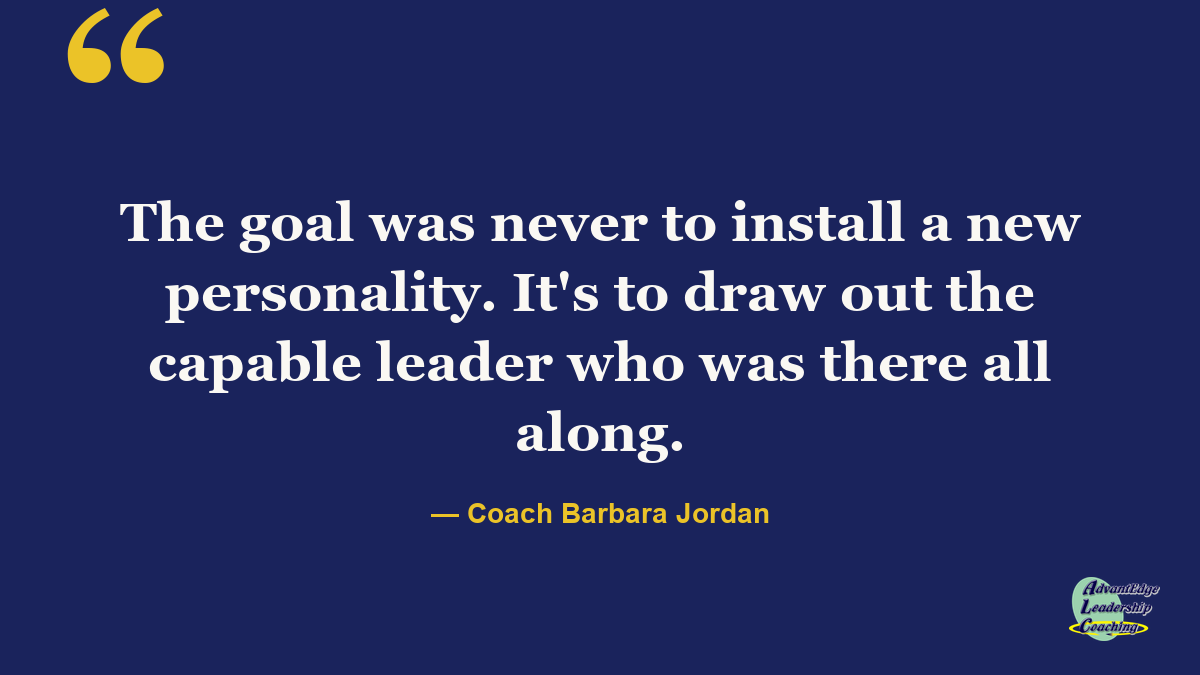
The best one-on-one leadership coaching doesn’t install a new personality. It draws out the capable leader who was there all along — with honest data, a clear goal, one habit at a time, and steady support. That’s the work I do with leaders at AdvantEdge Leadership Coaching. Missed the first half? Read Part 1, on orientation and group coaching, or see how it fits into a full leadership development program. If you’re investing in a new or emerging leader, explore my coaching & training services or reach out for a conversation.
If any of this resonates with you, contact me! I’d love to work with you! I coach leaders who are ready to get to the next level, without it costing them anything. They’re not looking to be fixed — they’re looking to grow: to make hard calls with less second-guessing, to lead through change without losing confidence, and to have the capacity to thrive, not just survive.
The leaders I work with are already performing well. Yet decision fatigue, overwhelm, conflict & stress can be challenging. And because they’re the person everyone else goes to… They seldom have someone safe to help themselves.
After all, the strongest leaders don’t just push harder. They grow from the inside out. By “from the inside out”, I mean that you develop more than just skill sets. We work on emotional intelligence and winning mindsets too. Since I’m a trained clinician AND certified leadership coach — we go deeper than tips, techniques and frameworks. If you want more than information, work with a coach like me, who provides transformation.
Barbara Jordan, LPC, Certified Leadership Coach
LPI (Leadership Practices Inventory) 360-FeedbackCertified Coach
DISC Certified Behavior Analyst
Cutting Edge Coaching “from the inside-out”.
More than just skill sets–mindsets too.
Beyond information, to TRANSFORMATION!
One Comment
Comments are closed.